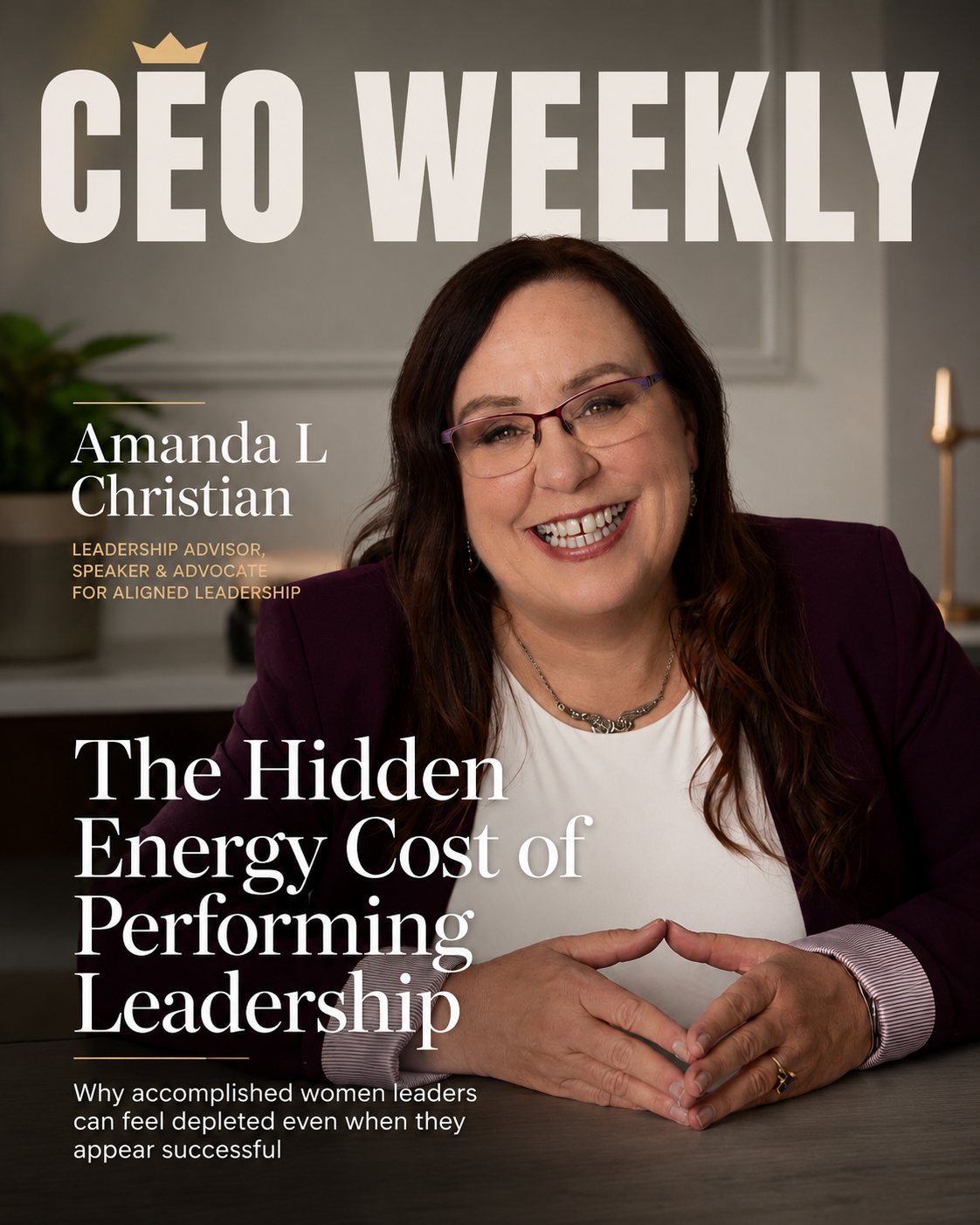
The Competence Paradox for Women Leaders

There’s a pattern I started noticing after years inside executive environments. It didn’t show up in strategy decks or performance metrics. It showed up in how highly capable women spoke in rooms where they were already the most experienced voice.
Years ago, when I was still leading technology teams inside a global bank, I sat in more strategy meetings than I can count. When you spend that many years in executive environments, you begin to notice patterns that never show up in leadership training programs. They are not the obvious patterns about budgets, performance metrics, or corporate strategy. They are the human patterns that silently shape how authority operates in a room.
One moment from those years has stuck with me.
There was a woman in a meeting who had the most experience at the table. She had spent two decades in the industry and understood the technical landscape better than most of the people present. When the problem became complicated, people instinctively turned toward her. She didn’t just see the answer. She saw everything that could impact the answer. The trade-offs. The downstream effects. The people it would affect. She had the kind of analytical clarity that teams rely on when decisions carry real consequences.
And during that meeting, I noticed something subtle.
Every time she offered an insight, she softened the beginning. She would say something like, “I might be wrong, but…” or “This may not be the right angle, but…” before sharing a perspective that later proved to be exactly right.
I watched the room carefully. No one challenged her thinking. In fact, several people nodded immediately after she spoke. Yet she still approached each contribution as though it needed a small disclaimer.
Walking out of the building afterward, I remember thinking about what I had just witnessed. That moment reflected something I had begun to notice in many rooms over the years. Some of the most capable women leaders I worked with carried extraordinary expertise. Yet many of them also had an internal habit of verifying their authority before using it.
At the time, I could see the pattern. It would take years to understand why it happens.
Why experienced women leaders still second-guess themselves
If you have spent time leading in finance or technology, you may recognize this dynamic immediately.
Many women leaders develop an exceptional ability to read a room. They notice subtle changes in tone. They register shifts in body language before anyone says a word. They think through the possible reactions to an idea before presenting it. They measure timing carefully and often phrase their contributions in ways that maintain collaboration rather than confrontation.
These are not weaknesses. They are sophisticated leadership skills.
In fast-paced corporate environments, especially in industries where the margin for error is small, the ability to interpret social dynamics is enormously valuable. Leaders who can anticipate tension, understand competing interests, and navigate complex personalities often become the people organizations rely on when situations become difficult.
Over time, many women become remarkably skilled at this form of awareness.
But there is a side effect that rarely gets discussed.
When you spend years calibrating yourself in relation to everyone else in the room, you begin to treat your own perspective as something that requires verification. Before speaking, you run a rapid internal assessment. Is this the right moment to say it? Is there another angle I should consider first? How might this land with the people making the final decision?
This process often happens so quickly that it feels automatic.
Meanwhile, someone with less experience may simply state an opinion with confidence and move on. The room interprets that confidence as authority, even when the analysis behind it is thin.
What fascinates me about this dynamic is that the hesitation many women experience is not due to uncertainty about the subject matter. In many cases, it appears precisely when a woman knows she is right.
She has already analyzed the situation. She has already evaluated the risk. She understands the implications more thoroughly than most of the people present.
Yet she still feels the need to soften the delivery.
That habit is rarely about communication skills alone. More often, it reflects a deeper pattern I explored in The High Cost of Polish, where refinement stops being a matter of effectiveness and becomes a form of self-protection. Many women leaders are not polishing their ideas because the ideas are weak. They are polishing them because experience taught them that how something is said can matter as much as whether it is true.
Not because she lacks competence, but because she has learned that authority operates differently depending on who is expressing it.
The leadership conditioning most women leaders never see
Over the years, I have come to see that what many women interpret as self-doubt is often something else entirely. It is the result of long-term leadership conditioning.
In male-dominated industries, women often receive subtle signals early in their careers that shape how they express authority. These signals are rarely delivered directly. Instead, they appear in small moments of feedback, reactions in meetings, or informal comments that suggest certain behaviors are more acceptable than others.
Be collaborative rather than forceful.
Present ideas carefully rather than decisively.
Invite discussion rather than state conclusions.
Individually, these messages may seem reasonable. Collectively, they create an environment where women learn to regulate the expression of their authority.
Many respond by developing extraordinary observational skills. They become highly attuned to interpersonal dynamics and can navigate complex social environments with precision. Those abilities often contribute significantly to their success.
But the same awareness that helps them lead effectively can also turn inward.
Instead of trusting their initial read of the situation, they begin evaluating their own judgment relative to everyone else in the room. Their thinking becomes layered with internal checks that are rarely visible to others.
This is also where authority can begin to blur. I wrote about a neighboring dynamic in Why Composure Replaces Clarity at Senior Levels, where the appearance of steadiness takes priority over directness. In many senior environments, women learn to manage the room so well that they can end up managing themselves right out of the full force of their own clarity.
Ironically, this means the leaders who are often most thoughtful and analytically rigorous may also be the ones who hesitate before asserting what they already know.
Another factor I have observed is that many high-performing women build their careers inside systems that reward endurance and performance above all else. Success becomes closely tied to external evaluation. Promotions, compensation, and recognition are tied to measurable outcomes and approval from senior leadership.
Over time, it becomes easy for a leader’s internal compass to orient itself toward external validation rather than personal authority.
When that happens, even highly capable professionals may begin looking to the room for confirmation before trusting their own conclusions.
What changes when authority comes from within
One of the most important shifts in leadership does not involve communication techniques or executive presence. It involves orientation.
Many leadership models focus on projecting authority outward. Speak clearly. Communicate decisively. Establish your presence in the room.
Those elements matter, but they are not the foundation of authority.
The deeper shift occurs when a leader stops treating the room as the primary reference point for determining what is valid. Experience becomes part of the data. Judgment becomes something that carries weight without needing immediate approval from others.
This does not mean ignoring colleagues' perspectives or abandoning collaboration. Leadership always involves listening, evaluating, and integrating multiple viewpoints.
The difference lies in where the leader begins.
When internal authority is established first, a leader enters the conversation as a contributor rather than a candidate seeking validation. Her insights are offered as part of the analysis rather than presented cautiously for review.
The external behavior may appear similar. The tone may remain thoughtful and collaborative. Yet the internal posture is entirely different.
Over time, others sense that difference.
Authority becomes visible when it is anchored internally before it is expressed externally.
Looking back across the many rooms I sat in during my years in corporate leadership, I can see how often this pattern appeared.
Some of the most insightful leaders I worked with were women who carried decades of experience and extraordinary analytical ability. Yet many of them approached their own authority with a level of caution that their male counterparts rarely considered necessary.
The irony is that their hesitation rarely reflected a lack of competence. It reflected the social conditioning of environments where authority had historically been defined in ways that did not always include them.
If you have ever walked out of a meeting and realized that the idea everyone eventually supported was the one you almost did not say, you are not alone.
Many accomplished women leaders have spent years developing the habit of internally reviewing their authority before expressing it.
The question worth considering is not whether you are capable. Your career has already answered that.
The question is whether the systems you learned to operate within trained you to trust the room more than you trust your own experience.
And if that is true, what might change if your own judgment became one of the primary reference points again?
Leadership becomes very different when authority no longer waits for permission.
If you recognized yourself in this dynamic, you are not imagining it. Many accomplished women leaders experience this moment where their expertise is clear, yet something inside them still pauses before claiming it.
And I would love to hear your perspective.
Have you ever experienced a moment where you realized you had the clearest read of a situation in the room, yet still hesitated to claim it?
Those moments often reveal far more about leadership than any training program ever will.
If you’re recognizing this pattern in your own leadership, it’s worth looking at more closely.
You can book a Private Coaching Strategy Call with me. We’ll explore where you may be internally calibrating instead of trusting your own judgment, and what it would take to re-establish a sense of authority that doesn’t require permission from the room.
Inbox clutter is exhausting. This isn’t that.
If you’re a high-achieving woman who’s done with leadership models that drain you, this is where it shifts.
You’ll get a monthly leadership newsletter, and the occasional insider-only invite.
Built for women who don’t have time to waste and don’t want to.
We hate SPAM. We will never sell your information, for any reason.