The Treadmill Doesn't Stop: What the Absence of Pause Actually Costs You

You did not lose yourself. You are running a machine that was never designed to let you stop. And if you have started feeling disconnected from yourself in ways you cannot quite name, that is not a personal flaw. That is the machine doing exactly what it was built to do.
If you have spent any significant time in Finance or FinTech, you already know the pace I am talking about. Not the busy kind that comes in waves. The kind that has no perceptible floor. The kind where one project closes and the next one is already on fire before you have had time to register that the last one ended.
The Calendar That Was Never Yours
Most industries have a natural rhythm. Retail slows in January. Academic calendars reset. Even healthcare has its seasonal cadences. Finance and FinTech do not work that way. They run on a regulatory calendar, and that calendar was not built around the human beings inside it. It was built around reporting cycles, audit windows, compliance deadlines, and systems processing. The one moment in the year that even approximates a pause is Year-End. And if you have been around long enough, you know that Year-End is not a pause. It is a different kind of execution. The treadmill just changes its angle. I know this not as a structural observation but as something I lived for years.
The role I kept getting, whether or not it was the one on paper, was the one nobody wanted: walk into the fire, put it out, move to the next one. That became the pattern over my career, whether it was global teams, initiatives, projects or programs. Later in my career, it became a pattern of one failing project stabilizing, another already in flames, and, somewhere in the middle of that, I was also coaching other project managers to keep their programs from going under. Not because anyone asked whether I had the capacity for it. Because it was assigned. No adjustment to the workload. No recognition in the compensation. Just more. Always more. It literally felt like running at top speed on a treadmill locked in sprint mode with no off switch, no slower setting and no exit.
What I did not understand then, and what I want to name clearly for you now, is that the cost of that sustained sprint is not just fatigue. Fatigue, you can sleep off. The cost I am talking about is something slower and harder to see. It is the gradual loss of your own signal.
When the Running Leaves You Disconnected
When you are in execution mode for years without a genuine pause, something erosive happens. You stop hearing yourself. Not dramatically. Not all at once. It happens in increments. The inner voice that used to say "something about this role doesn't fit anymore" gets quieter, because there is no space in which to listen to it. The instinct that once told you when a situation was costing you more than it was returning gets harder to access, because accessing it requires a stillness you have not had in years.
I wrote about this in a different frame in "The Erosion of Judgment," exploring how the very faculties that make senior women effective are the first things that get quietly dismantled by environments that extract everything and restore nothing. The erosion is not a crisis. It is a drift. And drift is almost impossible to detect when you are moving fast.
The question most women ask at this stage is "Why am I so tired?" It is the wrong question. The right question is: What have I lost access to while I was running?
The Trigger Is Not a Season. It Is a Moment.
Here is what I have noticed, both in my own experience and in the women I work with now. Recalibration does not happen on a schedule. There is no January reset, no spring renewal built into the structure of these industries. What actually triggers the moment of "I need to stop and look at this" is almost always a specific event landing atop accumulated pressure.
A performance review that stings in a way you cannot quite articulate. A reorg that reshuffles the deck, and suddenly you are no longer sure where you stand. A promotion that went to someone else, and the surprise of your own reaction tells you something you had not been willing to hear. A birthday that ends in a 2 a.m. thought that does not match the life you thought you were building. A colleague was laid off, and the flicker of envy you feel before you catch yourself.
These moments are not crises. They are signals. In "The Signal Leaders Ignore Before a Bad Decision," I made the case that the most consequential information a senior leader ever receives often comes from exactly these moments. The ones that feel personal when they are actually diagnostic.
The problem is that a system running you at full sprint has no mechanism for you to stop and process what just happened. So most women do what the environment has trained them to do. They absorb the signal, file it somewhere, and keep running.
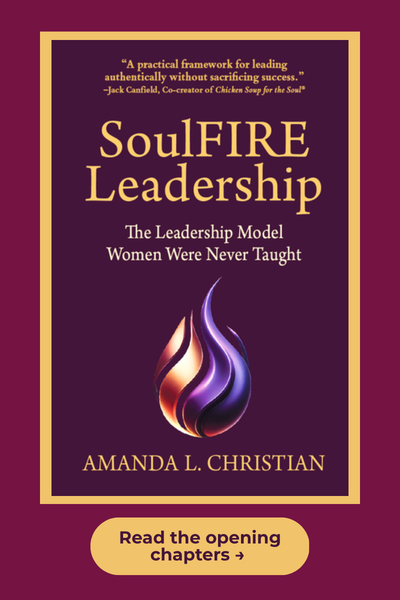
That is what I kept coming back to while writing my soon-to-be-released book, SoulFIRE Leadership. If you have been running so long that you have lost the thread back to your own instincts, that is not a personal failure. It is what happens when a system extracts everything it can and offers nothing back.
SoulFIRE Leadership was written for exactly this moment. It is the framework I wish I had during 33 years on that treadmill, a way back to your own signal, your own authority, and a way of leading that does not require you to disappear. Get your copy HERE.
Naming What This Actually Is
Here is the reframe I want to offer you directly, because I think it matters.
The disconnection you feel from your instincts, from your clarity about what you want, from the version of yourself that had opinions and preferences and a sense of direction that was not entirely shaped by what the institution needed from you: that disconnection is not a personal failure. It is a structural outcome. You were not weak. You were inside a machine that was never designed to support your inner life. It was designed to use your capacity and call it an opportunity.
Before You Move On
This week, find fifteen minutes. One coffee break. One lunch where you do not eat at your desk. One commute where you put the phone down. Sit somewhere with no task attached to it, no agenda, nothing to listen to or read or respond to. Just you and whatever surfaces.
If nothing surfaces, that is fine. If something does, let it be there. You are not solving it. You are not analyzing it. You are simply stopping the machine long enough to hear whether you have anything to say to yourself.
Most women I work with tell me the first time they try this, it feels almost physically uncomfortable. That discomfort is not a sign that it is not working. It is a sign of how long the treadmill has been running.
What Comes After the Recognition
Here is what I actually mean when I say constructed pause, because I do not mean a vacation you cannot take or a retreat you cannot justify to your calendar.
I mean, fifteen minutes on a Tuesday that you treat as non-negotiable. Not to meditate. Not to journal if that is not you. Just to sit somewhere without a task attached to it and let your mind report back. Most senior women in Finance and FinTech have not done this in so long that the first few times feel almost physically uncomfortable. That discomfort is information. It tells you how far the drift has gone.
What you are listening for is not a revelation. It is smaller than that. You are listening for the thing you noticed and immediately set aside. The meeting that left you flat in a way you could not explain. The project you said yes to while something in you said no. The moment you caught yourself performing enthusiasm you did not feel. These are not complaints. They are data points. And they only become audible when you stop moving long enough to hear them.
The constructed pause is not about fixing anything. It is about restoring enough contact with yourself to tell the difference between "I am tired" and "I am done." Between "this role is hard right now" and "this role stopped fitting me two years ago." That distinction matters enormously. You cannot make a good decision from inside a sprint. You can only react.
Thirty-three years inside this system taught me that the women who navigate it well are not the ones who found a way to run faster. They are the ones who found a way to stay in contact with themselves while the machine kept moving. That is a skill. It is learnable. And it starts with something smaller than you think.
The Question That Matters
What would you hear if the treadmill stopped for one hour?
If you are in an acute moment, a recent reorg, a role that no longer fits, a sense that something has to change, you can also book a Private Coaching Strategy Call. We will look at where you are and what the path forward actually looks like. Book your call HERE.
Inbox clutter is exhausting. This isn’t that.
If you’re a high-achieving woman who’s done with leadership models that drain you, this is where it shifts.
You’ll get a monthly leadership newsletter, and the occasional insider-only invite.
Built for women who don’t have time to waste and don’t want to.
We hate SPAM. We will never sell your information, for any reason.