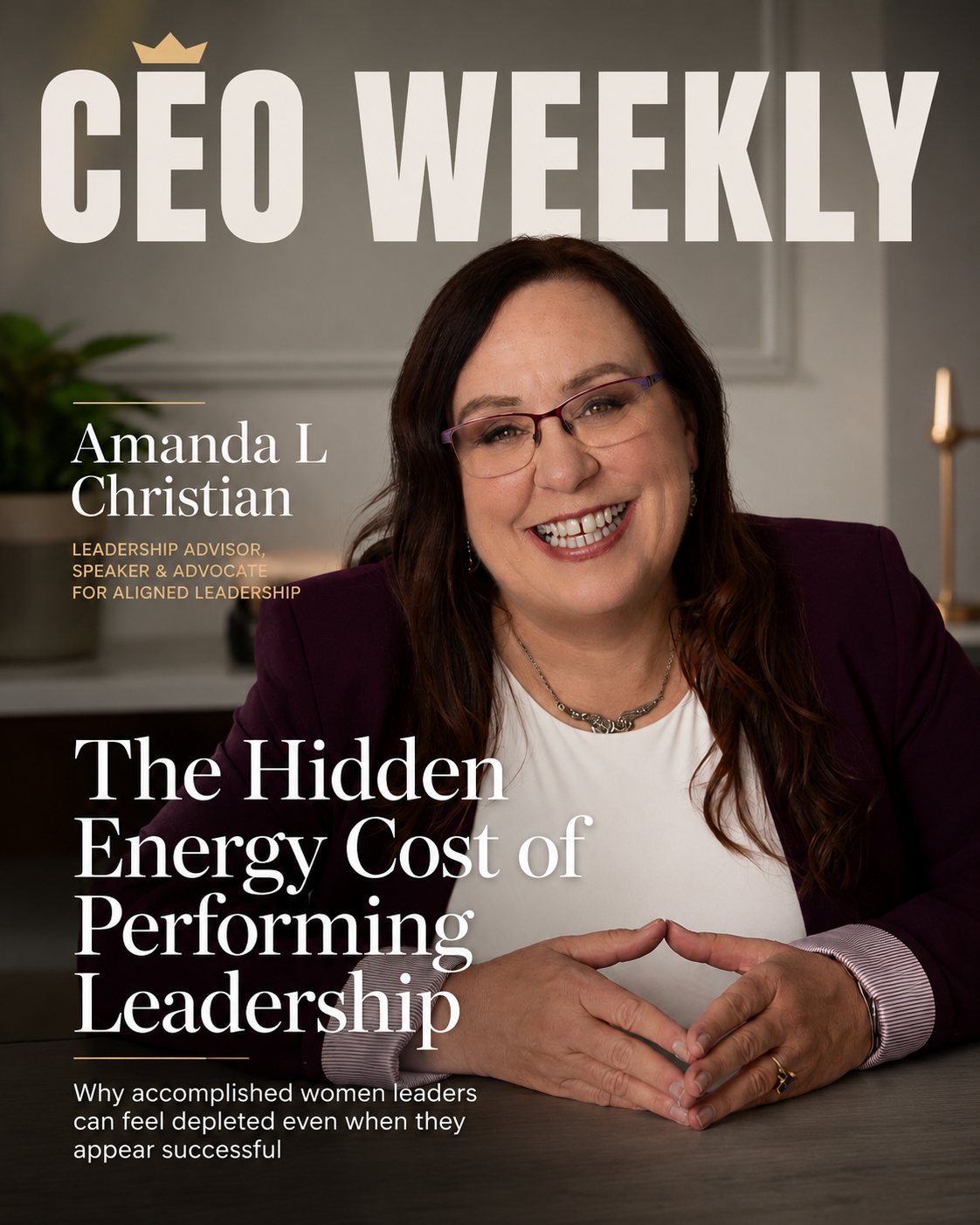
The Shift Most High-Performing Leaders Don’t See Coming

There was a period in my career where, on paper, everything was working exactly as it should. I was leading large-scale technology initiatives inside a global bank, sitting in rooms where decisions carried real financial and operational consequences. These were environments I had spent decades preparing for, and by that point, I understood both the technical landscape and the human dynamics that shaped those conversations. I knew how to navigate the room. I knew how to move a decision forward. I knew how to lead.
And yet, something began to feel different in a way I couldn’t immediately explain. There wasn’t a moment when anything broke. Just a growing sense that something that used to feel natural now required more attention.
I remember walking into meetings fully prepared, clear on my perspective, and still finding myself thinking about how I would say something before I said it.
There was a period in my career where, on paper, everything was working exactly as it should. I was leading large-scale technology initiatives inside a global bank, sitting in rooms where decisions carried real financial and operational consequences. These were environments I had spent decades preparing for, and by that point, I understood both the technical landscape and the human dynamics that shaped those conversations. I knew how to navigate the room. I knew how to move a decision forward. I knew how to lead.
And yet, something began to feel different in a way I couldn’t immediately explain.
I remember walking into meetings fully prepared, clear on my perspective, and still finding myself thinking about how I would say something before I said it. Not because I was uncertain about the idea itself, but because I was aware of how it might land with different people in the room. It was the accumulation of what I was carrying before I said anything.
More awareness of the room.
More consideration of competing priorities.
More responsibility for how decisions would land across the organization.
None of it was wrong. And over time, it added weight to moments that had once felt simple. And I could feel the effort behind it. Not in the work itself. In what it took to stay aligned while doing it.
The more skilled I became at doing it, the harder it was to recognize that anything had shifted at all. It felt like refinement. It felt like growth. And it also felt like something that had once been natural now required maintenance.
That was the moment I began to question something I had never questioned before. Not whether I was capable, but whether I had started to treat leadership as something I needed to perform rather than something I could inhabit.
Over time, I began to recognize this same pattern in other women I worked with, particularly those who had built strong careers in finance and technology. It rarely showed up early. Early on, the focus is clear. Learn quickly, deliver results, establish credibility. Many of the women I worked with became exceptionally good at that. They were prepared, thoughtful, and able to navigate complex environments with a level of awareness that made them highly effective. This is something I see often with high-performing women in finance and technology, where leadership begins to shift from expression into internal management without them realizing it.
But awareness evolves over time.
As responsibility increases, so does exposure. There are more stakeholders, more competing interests, and more subtle dynamics to manage. And somewhere along the way, awareness stops being directed outward and begins to turn inward. It becomes less about understanding the room and more about positioning yourself within it. Anticipating reactions. Calibrating delivery. Tracking how your words are being received while you are still in the middle of speaking them.
None of this is dramatic. In fact, it is often rewarded. It makes conversations smoother. It reduces friction. It signals professionalism and control. But it also introduces a quiet division in attention. Part of you is engaged in the conversation itself, while another part is monitoring how it unfolds through the lens of how you are perceived.
That division is where the experience of leadership begins to change.
Leadership depends on presence. The ability to stay with what is actually unfolding, to think clearly in real time, and to respond from a place that is connected to your own understanding of the situation. When your attention is split, even slightly, that connection weakens. Not in a way that others can easily see, but in a way that you begin to feel.
This is often the moment when something that used to feel straightforward starts to feel heavier than it should. Not because the work itself has changed, but because of the way you are holding it.
I wrote about a related moment in The Signal Leaders Ignore Before a Bad Decision, where leaders feel a subtle hesitation just before moving forward with something that appears fully aligned. It’s easy to dismiss, especially when everything looks correct on paper and the room is aligned. But that hesitation is often the first indication that something internal is being set aside in order to keep the process moving. What’s important here is that this pattern doesn’t stay contained to decision-making. It begins to shape how a leader engages in the room more broadly.
Once you start to see it, you begin to recognize how that same internal adjustment shows up in other places.
It appears in how ideas are introduced. It appears in how disagreement is handled. It appears in the small, almost imperceptible moments where a leader reshapes her own thinking before allowing it to fully land. Over time, these adjustments become so integrated into how someone leads that they stop feeling like adjustments at all. They feel like part of the role.
This is where the experience of leadership quietly shifts from expression to management.
I saw another version of this pattern in a different context, explored more deeply in The Competence Paradox for Women Leaders, where highly capable women would qualify their thinking before sharing it, even when their perspective was the most accurate in the room. That habit wasn’t about uncertainty. It was the result of years spent refining how their ideas were received, to the point where that refinement began to filter their own voice before it fully emerged.
When you step back and look at these patterns together, something deeper becomes visible.
This isn’t about confidence, and it isn’t about communication technique. It’s about orientation. In high-performance environments, most leadership development is focused outward. How you present. How you influence. How you are perceived. Those skills matter, but over time, they can train leaders to reference the room before they reference themselves.
That shift is subtle but significant.
Because once your primary reference point becomes external, your leadership begins to organize around it. You begin to sense what will land well before you fully acknowledge what you actually think. You shape your expression in real time, often so seamlessly that it feels natural. And this is where leadership starts to feel like performance, not because it is inauthentic, but because it is being continuously adjusted.
When that pattern begins to unwind, the change is not dramatic but unmistakable.
It starts with a different internal starting point. Before considering how something will be received, you allow yourself to fully register what you see. The analysis you’ve built through years of experience becomes primary again, rather than something that needs to be shaped before it is expressed. You still take the room into account, but you are no longer editing your thinking in real time to match it.
That shift has a practical effect on energy.
When you are no longer running a parallel process of self-monitoring, your attention consolidates. Listening becomes more complete because you are not preparing your next sentence while someone else is speaking. Your responses become more precise because they are not being filtered through multiple layers of adjustment. Conversations move more cleanly, even when they are complex or uncomfortable.
And something else changes that is harder to measure but easy to recognize.
The room responds differently. Not because you are trying to influence it differently, but because there is less distance between what you are seeing and what you are saying. People sense that consistency. It creates trust not by relying on performance, but on the absence of it.
This is often the point where leadership begins to feel more sustainable again. Not easier, but more direct. Less managed. More aligned with how you actually think.
If there is one place to begin noticing this in your own leadership, it is not in a high-stakes moment. It is in the smallest ones. The next time you are about to speak, notice whether you adjust first. Not dramatically, just slightly. Notice where that adjustment is coming from.
That moment is usually where the shift begins.
If this puts language to something you’ve been feeling but haven’t been able to fully name, that’s usually where real change starts. You don’t need another leadership framework. You need to see clearly what’s actually driving the effort behind how you’re leading.
If you’re ready to look at that more closely, you can book a Private Coaching Strategy Call with me. We’ll explore where your leadership has shifted toward management rather than expression, and what it would take to bring it back into alignment.
Inbox clutter is exhausting. This isn’t that.
If you’re a high-achieving woman who’s done with leadership models that drain you, this is where it shifts.
You’ll get a monthly leadership newsletter, and the occasional insider-only invite.
Built for women who don’t have time to waste and don’t want to.
We hate SPAM. We will never sell your information, for any reason.