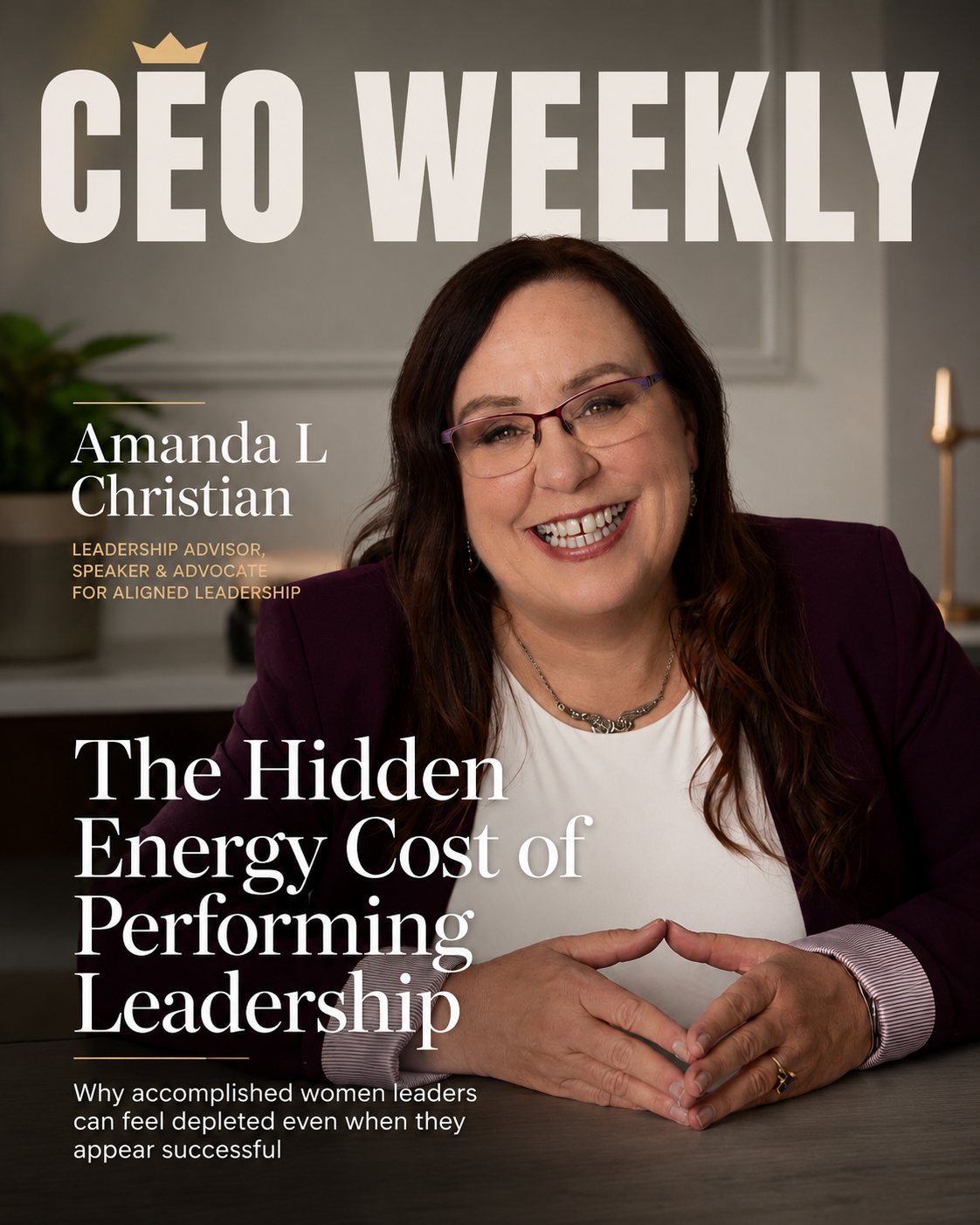
What “Executive Presence” Is Actually Asking You to Erase

You rehearse before you walk into the room. Not because you are underprepared. Because somewhere along the way, you learned that how you say something matters as much as whether it is right, and that the margin for error is smaller for you than for the person sitting next to you.
You already know what executive presence feedback feels like to receive. You have been there. So have I.
In October of 2014, twenty-five years into my career, I was told I needed more executive presence. I asked what that meant. I got crickets. Not silence from someone thinking. Silence from someone who had nothing to give me. No specific behavior. No example. Just the directive, hanging in the air, and the clear expectation that I would go figure it out.
So I did what you probably did. I worked on all of it. Presence. Communication. How I held myself in a room. How I opened a meeting. How I delivered a decision. I hit every dimension of a standard no one could name, because if I could not identify the gap, I was going to close every possible gap I could find.
A year later, same manager. Same feedback. Executive presence.
That was the moment I understood what it had actually been asking me all along.
What Is Executive Presence, Really?
Executive presence is the combination of how you communicate, carry yourself, and command attention in a room. In most corporate environments, it has served as shorthand for how closely your leadership style matches a template built around a specific kind of authority, one not designed with women in mind.
Executive presence is a real and valuable part of senior leadership. The ability to command a room, communicate with authority, and project confidence under pressure matters. What I am talking about is something specific: the way the standard is applied to women in male-dominated environments, and what it consistently asks them to remove to meet it.
Here is the translation no one gives you. That template was codified in environments that, for most of their history, were built by and for one kind of leader. You know which kind. The model it describes, projected authority in a specific register, emotional containment, a particular kind of settled certainty, was drawn from observing that leader over a long period of time.
When your leadership does not match that template, the feedback arrives as a development need. It is not a development need. It is a design mismatch. And you cannot develop your way out of a design mismatch, which is exactly why you can spend a year working on every dimension of the standard and still receive the same feedback 12 months later, as if nothing happened.
The people delivering it are not always lying to you, nor are they always unaware. Sometimes the vagueness is confusion. Sometimes it is protection. It is considerably harder to say “you remind people you are a woman when you walk into a room” than it is to say “executive presence.” The imprecision is doing work.
Why Do Women Keep Getting Told They Need More Executive Presence?
In my experience over three decades in finance and technology, feedback on executive presence landed on women far more often than on men, and almost never with any specifics attached. A skills gap has a solution. A presence gap keeps moving.
I watched this for thirty-three years. A man would get feedback with a specific behavior attached. Something concrete he could work on. A woman would get presence. No definition. No example. Just presence, as if she would know what to do with that, as if the gap were obvious when it had never been named.
For women in leadership, the feedback rarely names what it is actually measuring. It measures the distance between how you naturally lead and how the template expects leadership to look. That distance is not yours to close. It belongs to the template.
The Three Things the Feedback Is Actually Measuring
The first is your emotional register.
You made the call. You knew it was right before you finished the sentence. And before you said it out loud, you did something you have been doing for so long you no longer notice. You softened it. Took the edge off. Made it something the room could accept without having to decide what to do with you. And even after all that translation, what came back was “too much” or “too direct” or some version of both, delivered in a tone carefully calibrated to sound like development feedback. The man to your left said something with identical force last week. What came back to him was “strong point.” You filed that, too.
There is a specific moment most women in this field know well. You are about to say something important in a high-stakes meeting, and in the half-second before you open your mouth, you run a calculation: How will this land? Too direct? Not direct enough? Am I about to get talked over? That calculation has become so automatic that you barely notice it anymore. But it costs something every single time. That cost is not a confidence problem. It is the executive presence standard running in the background of every room you walk into.
The second is how you think out loud.
You said it. Clearly. The conversation moved on. Eight minutes later, he said the same thing with different words, and someone wrote it down. You know exactly what you did with your face in that moment because you have done it before. You made it neutral. You may have nodded. You are that practiced at it. You did not make it a thing because you have already done the math on what it would cost, and you decided years ago it was not worth it. So you added it to the account. The one you have been keeping since the third or fourth time this happened, back when you still thought it might be a coincidence.
The third is how much space you occupy.
You are already at the table when you notice it. Already smaller than when you walked in. You do not remember deciding to be. Your shoulders have already made their decision. When you speak, your voice will come out slightly above where it actually lives, just enough to land as measured rather than as what it actually is. You did not choose any of this. You never do. It happens in the space between walking through the door and sitting down, in a gap so practiced it has no duration anymore. The thing that gets called a presence problem lives right there. Not in you. In the gap.
What Building Executive Presence Actually Costs You
By the time you receive this feedback at a senior level, you have been translating yourself for a long time. The directness softened. The instincts backed up with data before they were allowed out. The warmth calibrated by the room.
I wrote about this in “Being Easy to Work With Is Not a Compliment”, the women paying the highest translation tax are rarely the ones who look like they are struggling. They are the ones described as collaborative, diplomatic and a pleasure in every room. That praise is often a receipt. It means you have been doing it for so long that you have stopped noticing you are doing it at all.
The executive presence feedback asks you to convey that translation more convincingly. It is not asking you to stop. And every time you get better at performing, the gap between who you are and who you show up as widens, because performed presence does not hold. People do not consciously identify a performance, but they feel it. They comply rather than commit. They engage without following.
SoulFIRE Leadership was built around the signals women are taught to distrust, including this one. It is the framework for leading from your actual read of the room, not the version you were told was acceptable. Get more information and read 2 chapters for free here.
You are doing everything right. But right by whose standard? Because the standard you have been chasing was never written with you in mind.
What Your Presence Is Actually Worth
Here is what I watched across thirty-three years inside finance and technology. The collaborative intelligence that gets coded as soft? It is what holds a team together when the pressure is highest. The pattern recognition that does not move in a straight line catches the problem three weeks before the data confirms it. The emotional attunement that reads as too much in a flat-affect environment is what people orient toward when something is actually wrong, not the person with the best slide deck. I watched this play out in room after room. It was never soft. It was simply illegible to a system that was never designed to see it.
You already know which part of this is true because you have watched it. When something is actually wrong, your team does not go to the person with the most polished answer. They come to you. Not because of your title. Because of what they feel when they are in a room with you. That is not a soft skill. That is leadership. It has been that way your entire career. The standard just never had language for it.
In “The Leadership Skill That Separates Real Authority From Job Titles,” I wrote about what actually changes when a leader stops performing leadership and returns her full attention to the conversation. Rooms get more honest. Decisions move faster. People stop negotiating the truth before they speak it. That is not the result of developing better executive presence. It is what happens when the performance requirement is dropped entirely.
The Answer I Should Have Received
If someone had been able to answer my question honestly that day in 2014, it would have sounded something like this: Your leadership does not match the template we recognize as authority. The template was built around someone who does not think the way you think, lead the way you lead, or read a room the way you read one. We do not have a language for what you are doing because we have not needed it before. So we are calling it a gap.
That is what executive presence feedback has always been, at its most accurate. A gap between your leadership and a template that was not designed for it.
You have had that meeting in your head. The one where you walk in and say the thing you actually think, in the way it actually formed, and watch it land. No adjustment before it leaves your mouth. No bracing for what comes back. Just you, fully in it. That is what this reframe makes available. Not because the room changes. Because you stop trying to fit a template that was never built around how you actually lead.
You don’t have an executive presence problem. You have a self-erasure problem. And those require completely different responses. The first one is simply knowing the difference.
Take the SoulFIRE Leadership Audit and find out exactly which patterns are costing you capacity, and which ones are your actual strategic edge. It is the most honest conversation most women in this field have ever had about their leadership. Start here.
#executivepresenceforwomen #executivepresencedefinition #whatisexecutivepresence #executivepresence #womeninleadership
Inbox clutter is exhausting. This isn’t that.
If you’re a high-achieving woman who’s done with leadership models that drain you, this is where it shifts.
You’ll get a monthly leadership newsletter, and the occasional insider-only invite.
Built for women who don’t have time to waste and don’t want to.
We hate SPAM. We will never sell your information, for any reason.