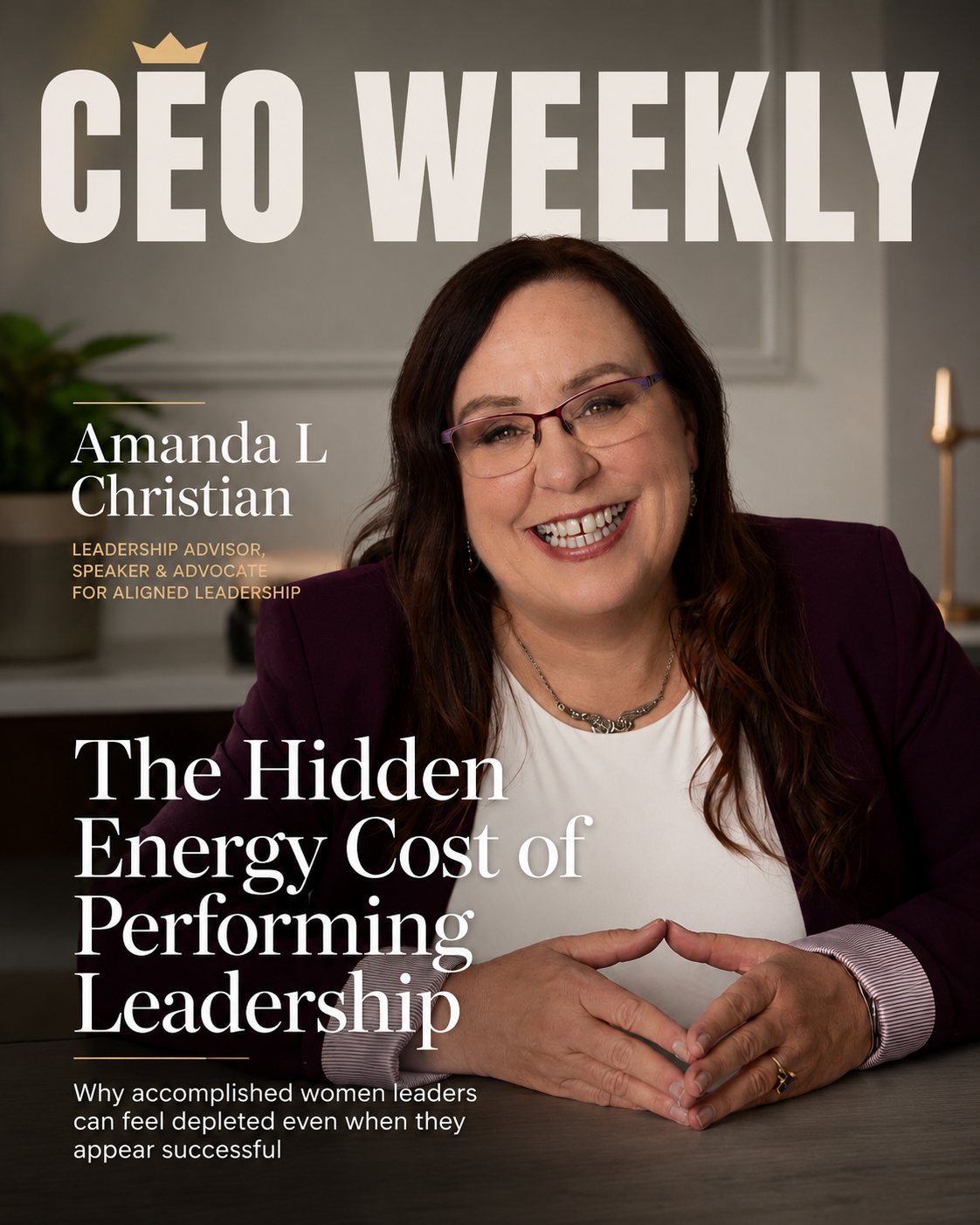
The Collapse: Why Executive Presence Fails From the Inside Out

You can be doing everything right and still feel like something is failing.
Your track record holds. Your authority is intact. By every external measure, leadership is working.
And yet, something fundamental no longer feels stable inside it.
Not because of a single moment or a visible misstep.
Not because of a loss of confidence or capability.
But because the way leadership has been carried out no longer matches the level of complexity it now entails.
This is the point many leaders misinterpret.
They assume the problem is stamina. Or presence. Or polish. They look for refinement, adjustment, or another layer of control because leadership still appears effective from the outside.
But what’s actually happening is more structural than personal.
The very strategies that once made leadership work, steadiness, self-regulation, and composure under pressure have begun to extract more than they give back. Not abruptly. Not dramatically. But over time.
This is not a failure of executive presence.
It’s the moment when a strategy that once protected leadership begins to limit it.
And understanding that distinction changes where the work belongs.
Naming the Pattern: What Is Self-Managed Leadership?
For many senior women, leadership has become a high-functioning act of constant calibration. You are not just leading the room; you are leading yourself through the room.
Self-managed leadership is the operating system running quietly in the background of your interactions. It looks like:
-
Constant self-monitoring: A split focus where part of your attention is on the work, while another part is watching how you are doing the work.
-
Internal editing: The microsecond pause before speaking, where you scan for risk, soften your language, or dilute your edge.
-
Managing emotional tone: The ongoing labor of appearing calm, measured, and “appropriate,” regardless of what the situation actually calls for.
-
Tracking impact over intuition: Prioritizing how a decision will land politically or socially over what your internal signal is telling you.
-
Choosing appropriateness over orientation: Selecting the response that fits the protocol rather than the one that addresses the truth.
This is not immaturity. It is not insecurity. And it is certainly not a lack of skill.
Self-managed leadership is a highly sophisticated survival strategy. It develops in environments where the margin for error is slim, and the cost of being misunderstood is high. You learned to manage yourself to protect your credibility, your dignity, and your seat at the table.
It worked. It got you here.
But what functions as a ladder in mid-career becomes a ceiling at the executive level. The very mechanism that once kept you safe now makes real presence impossible.
The Mechanism of Collapse: Why Presence Cannot Survive Self-Management
We often think of executive presence as something we do. A set of behaviors we perform. But presence is not a behavior. It is a state.
True presence depends on three internal conditions:
-
Internal coherence: Alignment between what you feel, think, and say.
-
Access to signal: The ability to read both the room and your own intuition in real time, without static.
-
Trust in inner timing: The confidence to speak or act when the impulse arises, not after it has been vetted internally.
Self-management disrupts all three.
When you are busy managing yourself, your attention is fractured. You cannot be fully present with others while simultaneously supervising the version of yourself that is interacting with them. Presence collapses because self-management inserts a delay between impulse and action.
You feel the intuitive hit to challenge a data point. Then the filter engages: Is this too direct? Should I phrase it as a question? You speak the edited version. By the time the words land, the energy behind them has already thinned.
This is the trade-off: potency for safety.
The more you self-manage, the less present you feel. The room grows heavier. The stakes feel higher. And so you tighten the grip, monitoring more closely, editing more carefully. What emerges is a leader who looks polished but feels hollow, performing leadership rather than embodying it.
By mid-afternoon, the cognitive load of that performance has taken its toll.
The Trap of “Presence Work”
This is why so much conventional advice about executive presence fails and often makes the problem worse.
The industry tends to treat presence as a stylistic issue: lower your voice, take up more space, stop apologizing. These tactics can be useful in isolation. But when applied to a self-managed leader, they simply give the internal manager more work.
“Stand tall” becomes another thing to monitor. “Speak slowly” becomes another thing to edit.
Presence training often improves performance. You may look more confident. You may sound more authoritative. But performance is not presence. Performance requires vigilance, and vigilance deepens self-management.
If this dynamic feels familiar, you may also recognize it from Stuck at Work? Here’s Why Executive Presence Advice Is Making It Worse, which explores how external fixes unintentionally strengthen the very pattern they’re meant to solve.
This is why you can leave a presentation to applause and still feel unsettled. The audience responded to the performance. You know you weren’t fully there.
Conclusion: A Structural Shift
If you finish this post thinking, I need to work on my presence, we have missed the mark.
But if you’re recognizing, I’ve been managing myself instead of leading from myself, and that’s why presence feels so fragile, then you’ve arrived at the real insight.
You do not need more polish. You do not need a better script. You do not need to improve your presence.
You need to stop treating yourself as the problem to be managed.
This is not a cosmetic change. It is a structural one. It is the recognition that the armor you built to survive is now too heavy to carry if you want to lead with clarity, authority, and ease.
Letting go of self-management does not happen overnight, and it certainly doesn’t happen in a public meeting. It is a private, rigorous process. One that dismantles the internal manager so the leader can finally step forward.
Executive presence does not disappear because you failed to develop it. It collapses because you outgrew the strategy that once kept you safe.
This is often the moment where the work becomes private.
Not because something is broken, but because something has shifted in how leadership is being carried.
If this is where you are, not burned out, not failing, but aware that leadership is costing more than it should, you can request a private Strategy Conversation here.
We’ll assess what is eroding clarity beneath performance and whether recalibration is warranted this season.
I work with a small number of senior women at a time. If this resonates, the next step is a conversation.
Inbox clutter is exhausting. This isn’t that.
If you’re a high-achieving woman who’s done with leadership models that drain you, this is where it shifts.
You’ll get a monthly leadership newsletter, and the occasional insider-only invite.
Built for women who don’t have time to waste and don’t want to.
We hate SPAM. We will never sell your information, for any reason.