Your Career Legacy Is Being Built Before You Leave

There comes a point in a long career when another difficult assignment stops proving very much.
You already know you can walk into a program that is behind, a function with unclear ownership, a politically complicated initiative, or a problem that crosses three departments and somehow belongs to none of them. You know how to find the missing information, get the right people into the room, make the tradeoffs, steady the work, and get something moving again.
You may have spent twenty or thirty years becoming that person.
That capability has built your career. It may have earned promotions, larger scope, credibility with senior leaders, and the assignments people give to someone they trust to get the work across the line.
But if you are considering what you want the next five or ten years of your career to produce, another question becomes harder to avoid:
What exists now because you led there that did not exist before?
Not simply what you finished, fixed, or delivered. What became part of the organization after your direct involvement ended? What changed enough to keep evolving without you? Who became more capable because you led them, and what did they go on to build?
That is where achievement begins to become career legacy.
What Is a Career Legacy?
Career legacy is often framed as reputation: what people remember about you, the values you represented, the mark you left, or how people experienced working with you. Those questions have value. For someone who has spent years leading people, programs, functions, or organizations, however, reputation is only part of the picture.
Leadership leaves operational evidence too.
Your leadership legacy includes the judgment, capability, systems, standards, and leadership capacity that continue after you are no longer personally directing them. It might show up in the way a function now makes decisions, an operating standard that became expected practice, a cross-functional relationship that no longer requires one person to hold it together, or someone you developed who later builds a strong team of her own.
Some of the clearest evidence may appear after your name stops being attached to what you created. The practice becomes simply how the organization operates. The person you developed becomes known for her own judgment. A process you helped establish gets redesigned because the business changed, yet the thinking underneath it remains. A standard you once had to defend becomes unremarkable because people now assume the work should be done that way.
Your contribution has moved beyond your individual performance and into the capability around you.
Achievement and Legacy Are Measured Differently
Achievement is easier to see because organizations are designed to record it. There was a goal, and you reached it. There was a troubled implementation, and you stabilized it. A major migration finished. A client stayed. A risk was contained. A new operating model launched. Performance reviews, promotion cases, project summaries, award nominations, and résumés all depend on identifying what happened and who contributed to the result.
Career legacy is harder to capture because much of its evidence appears later.
You may have moved on before someone you mentored is promoted into a leadership role. You may never see what a program looks like after two reorganizations and a technology change. The working relationship you spent years repairing between two functions may eventually become so routine that new employees have no idea those groups once struggled to work together.
A strong record of achievement does not automatically tell you what the organization retained from your leadership. Both matter, but they measure different things.
Achievement tells you what you delivered.
Career legacy shows up in what became more capable because of the way you led while delivering it.
A Process That Survives Is Not Automatically a Legacy
One of the easiest mistakes is to confuse persistence with impact.
You build a governance process, and five years later the organization still uses it. You establish a weekly operating review, and it survives three leaders. You create a framework for prioritizing work, and eventually people in another function start using some version of it.
Those outcomes can be meaningful. But survival alone proves very little.
Organizations can preserve ineffective processes for an astonishing amount of time. A procedure making it through several reorganizations does not mean it still serves the business. Sometimes inertia deserves most of the credit.
The stronger test is whether people understand the purpose underneath what you built. Can they identify which parts still matter? Can they tell when the business has changed enough to require a different approach? Can they improve the original model without losing the capability it was designed to create?
Durable leadership leaves room for evolution. If the only acceptable future is the exact system you designed, operated exactly the way you designed it, the organization may have preserved your work without absorbing much of the judgment behind it.
A better outcome may be that the process no longer looks like yours at all. People have simplified it, added to it, replaced parts of it, or taken the underlying principle somewhere you never expected.
The form changed. The useful thinking survived.
Documentation Can Capture Knowledge. Judgment Is Harder.
Anyone who has handed off complex work knows how much effort can go into capturing institutional knowledge. There are transition documents, procedures, decision trees, playbooks, project histories, SharePoint sites, architecture diagrams, meeting notes, escalation paths, and governance models.
Their limitation appears as soon as reality stops matching the documented path.
A regulatory requirement changes. A technical dependency behaves differently from expected. A senior stakeholder changes priorities halfway through the work. A vendor issue falls outside the contract language. Two legitimate business needs conflict, and there is no answer sitting in the playbook.
At that point, people need more than information. They need judgment.
They need to understand which variables matter, which risks deserve more weight, where flexibility is possible, and why the original rule existed in the first place. They need enough context to make a decision that may be different from the one you would have made and still arrive at a strong result.
This is one of the less visible forms of leadership impact. People are no longer reproducing your decisions. They are making sound decisions in circumstances you never had to confront.
That is a much more durable capability than knowing what you would have done.
What Actually Outlasts a Strong Leader?
Over time, leadership can become embedded in several places at once.
Part of it may live in judgment. People evaluate situations differently because they learned which questions to ask, which risks deserve attention, and which tradeoffs should not be rushed.
Part may live in capability. A function can handle greater complexity. Someone who once needed substantial guidance can now lead work that would previously have been outside her scope. A team is able to take on a problem that no one would have trusted it with several years earlier.
Part may live in infrastructure. Decision rights are clearer. Escalations happen earlier. Cross-functional meetings are better run. Commitments are more explicit. Standards that once depended on one person insisting on them become part of the operating environment.
And part may live in other leaders.
This is where the question becomes larger than whether someone can perform the work you once performed. A woman you developed takes what she learned, combines it with her own experience, and builds something you would not have built exactly the same way. She advocates for someone you have never met. She changes how her team makes decisions. She develops another leader who eventually takes responsibility for work none of you could have predicted when the original relationship began.
Your impact is no longer traveling through your direct involvement.
It has acquired a life of its own.
The More Revealing Test Comes After Conditions Change
A practice can look successful while the environment around it remains familiar. The more revealing test comes when the assumptions underneath it no longer hold.
The business reorganizes. Technology shifts. A new executive changes priorities. Headcount is cut. A team inherits responsibilities it did not previously own. A merger changes decision authority. The work itself changes enough that the original answer is no longer useful.
If people can respond intelligently, there is evidence that something deeper than a procedure survived.
They understand enough to adapt rather than merely preserve. They can decide which standards still matter and which need to change. They can apply the reasoning behind an old solution to a new problem without treating the old solution as sacred.
That is a stronger test of leadership legacy than whether people faithfully continue what you started.
Sometimes the evidence that your leadership lasted is that people eventually stop doing things your way.
They understand enough to create a better way.
Leadership Impact Can Travel Beyond the Original Work
Durable impact does not always stay inside the team where it began.
A practice developed in one program gets adopted elsewhere. A way of structuring a difficult decision starts showing up in other parts of the organization. A relationship between two functions changes how those groups work together long after the original leaders have moved into different roles. A standard that once belonged to one team becomes expected across a broader area.
This kind of spread is easy to miss because nobody sends you an annual report showing where your influence traveled.
You may find out years later that someone still uses a question you used to ask in project reviews. Or that a leader you worked with took an operating practice into another division, modified it, and built something stronger. Or you may never know at all.
Career legacy does not require attribution.
If an idea only has value while your name remains attached to it, it has not traveled very far.
The Leaders You Develop Should Eventually Become Unrecognizable as Yours
Leaders often take pride in the people they have mentored, sponsored, coached, or prepared for greater responsibility. There is good reason for that pride.
But the deeper result of leadership development appears when the person stops looking like an extension of the person who developed her.
She brings her own experience, judgment, temperament, strengths, and mistakes to the work. She handles situations differently than you would have. She makes calls you might not have made. Some will be better.
Eventually, she begins creating capability around herself.
She develops someone you never worked with. She creates a standard you never taught. She changes a process you once introduced because she now understands enough to see where it falls short.
At that point, the contribution has multiplied rather than simply transferred.
You helped someone become more capable. She used that capability to create more capability somewhere else.
You no longer need to be at the center of the story for your leadership to remain part of what made it possible.
Eventually, the Career Question Changes
Early in a career, achievement provides necessary evidence. Can I handle more responsibility? Can I operate at this level? Can I lead something this complex? Can I recover when it goes badly? Can I influence people who do not report to me?
Accomplishment helps answer those questions.
After decades of work, many successful women already have substantial evidence. They know they can walk into complexity, carry responsibility, negotiate competing priorities, recover a struggling initiative, and make difficult things happen. Another major assignment may still be strategically important, intellectually challenging, financially valuable, or personally satisfying. But it may also be proving something they have already proved many times.
That changes the way a next role can be evaluated.
Title, scope, compensation, authority, flexibility, leadership quality, and the substance of the work still matter. They should.
But another criterion can sit beside them:
What will I have the opportunity to build here that can become larger than my own performance?
One role may give you a bigger title while using most of your energy to solve the same class of problems you have already solved for years. Another may give you the chance to strengthen a function, change how decisions are made, develop people with significant potential, establish a standard that alters the quality of the work, or create something other leaders can take farther than you ever could.
Neither choice is automatically better.
The difference is that career legacy gives you another way to decide what deserves several more years of your professional life.
Your Career Legacy Is Being Built Before You Leave
Career legacy is not a retirement exercise. You do not need to be preparing to leave an organization, planning the end of your career, or trying to manufacture something grand enough to be called a legacy.
Much of it is built in ordinary leadership decisions.
You give someone a stretch assignment and support her long enough to develop judgment, not just survive it. You push for a clearer decision process because you are tired of watching the same ambiguity create the same problem. You repair a relationship between two groups so the next project does not require the same political maneuvering. You insist on a standard until the standard no longer depends on you insisting.
Some of what you build will disappear. Some should. Organizations change, people leave, technologies become obsolete, and better approaches replace older ones.
The goal is not permanence.
The more useful question is whether your definition of career success has become too narrowly attached to what you personally completed.
Achievement records what you did. Career legacy asks what exists, evolves, or multiplies because you did it.
After a career spent proving what you can accomplish, that may be a better question for deciding what is worth building next.
Go Deeper
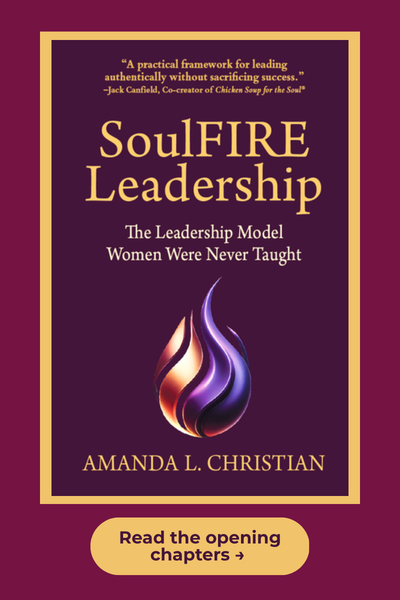
Legacy Over Achievement is one of the leadership principles I explore in Soulfire Leadership: The Leadership Model Women Were Never Taught.
The book looks beyond individual performance to the kind of leadership that develops judgment, strengthens capability, and creates change without requiring you to remain at the center of it.
Inbox clutter is exhausting. This isn’t that.
If you’re a high-achieving woman who’s done with leadership models that drain you, this is where it shifts.
You’ll get a monthly leadership newsletter, and the occasional insider-only invite.
Built for women who don’t have time to waste and don’t want to.
We hate SPAM. We will never sell your information, for any reason.