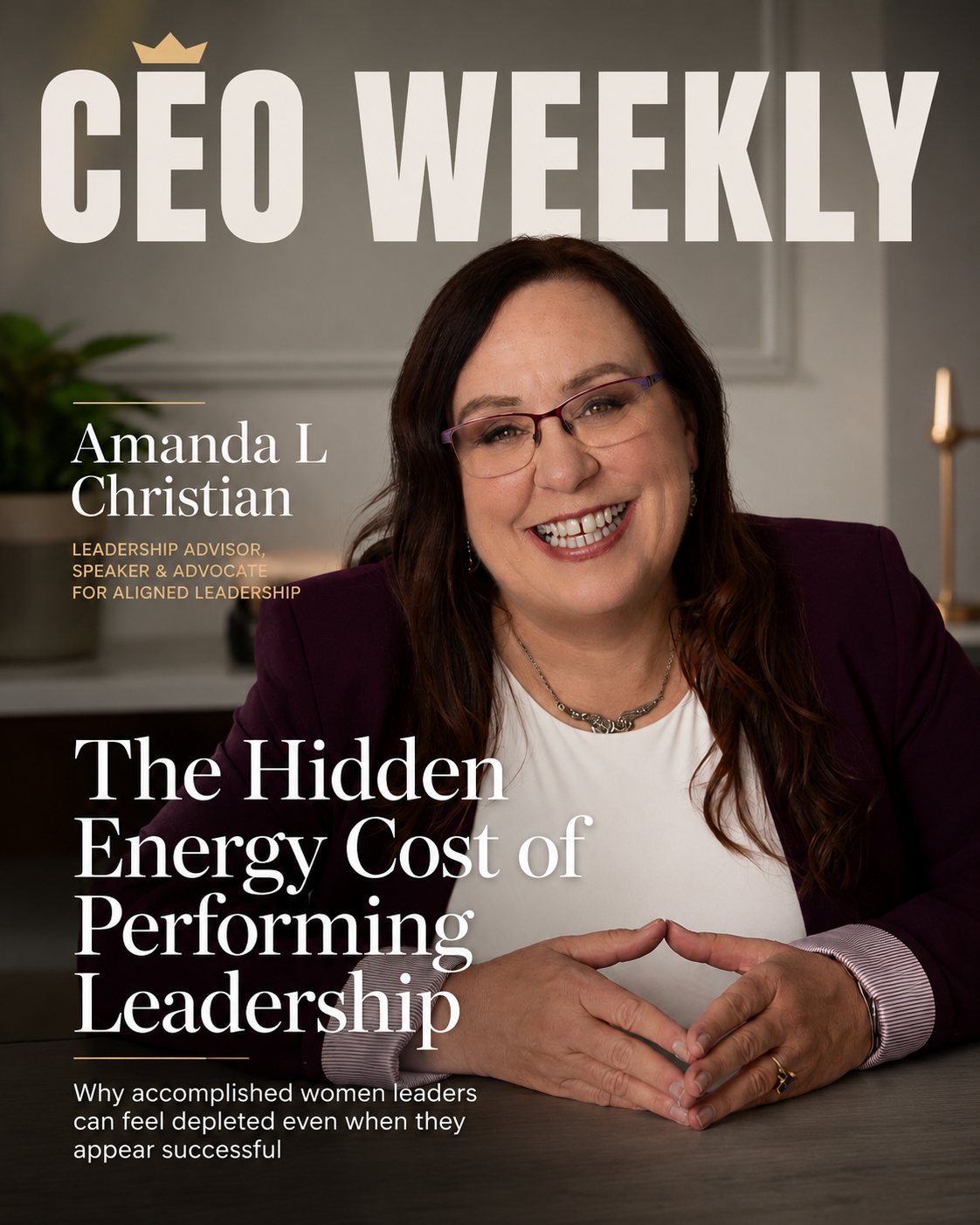
The Hidden Cost of Executive Presence

Executive presence is often treated as evidence of internal clarity.
If you look composed, it’s assumed you’re also oriented.
If you can steady the room, it’s assumed you know exactly where you stand.
But steadiness and clarity are not the same thing.
Executive presence can be sustained in more than one way — and not all of them are neutral internally. What often goes unexamined is how composure is being achieved, and what it requires from the person sustaining it.
At senior levels, presence is rarely accidental. It’s learned, reinforced, and rewarded. Leaders are taught — explicitly and implicitly — to regulate expression, manage uncertainty privately, and project confidence even when internal signals are less settled. Over time, this becomes automatic. Composure shifts from a choice to an expectation.
What’s far less discussed is what maintaining executive presence actually requires over time. Not on paper. Not in theory. But internally — in the form of sustained self-monitoring, emotional containment, and the quiet effort of holding steadiness in place.
That effort is rarely named. And because the external signal remains strong, the internal cost often goes unnoticed — until clarity starts taking more work to access than it used to.
Executive Presence as a Learned Performance
Most leadership environments implicitly teach that presence is something you project. You learn to steady your voice, manage your expressions, regulate your emotional range, and speak with conviction even when uncertainty is present. You learn to look unflappable, decisive, and composed — particularly when the stakes are high.
These behaviors are often praised as professionalism. They are reinforced through feedback, promotion decisions, and cultural norms. Over time, they become automatic. You no longer think about managing your tone or posture; you simply do it. Presence becomes less a choice and more a reflex.
The problem does not lie in the behaviors themselves. The problem lies in what happens when presence becomes something that must be continuously maintained, regardless of internal state. When composure is achieved not through regulation, but through suppression. When leadership requires not only strategic thinking, but also constant self-monitoring.
The Invisible Labor Behind “Looking Calm”
What is rarely acknowledged is the amount of internal work required to sustain this version of presence. While you are leading a conversation, you are also tracking how you are being perceived. You are adjusting your language in real time, calibrating your responses, and containing reactions that feel inappropriate or risky to express.
This dual attention — doing the work while managing the self — creates a persistent cognitive load. It is subtle, and it is not insignificant. Over time, it competes with the very capacities leadership demands: clarity, discernment, and the ability to think beyond the immediate moment.
Many leaders begin to notice this as decision fatigue. Choices that once felt straightforward now feel heavier. Strategic thinking becomes effortful. You may find yourself defaulting to familiar patterns, delaying decisions, or feeling mentally depleted after interactions that appear routine on the surface. This is not a personal failing. It is the predictable result of sustained internal management.
I’ve written before about the hidden cost of always being the stable one — not because steadiness is a flaw, but because it is so often achieved through unacknowledged self-regulation. Executive presence frequently draws from the same internal reserve. What looks like composure is often adaptation. What looks like strength is often sustained containment.
The Nervous System Cost of Contained Leadership
There is also a physiological dimension to this cost that is even less visible. When you feel stress, pressure, or uncertainty and override its expression in order to appear composed, your nervous system does not register safety. It registers restraint.
Composure achieved through suppression keeps the body in a low-grade state of activation. Stress responses are contained rather than resolved. Over time, this creates a baseline of tension that never fully releases, even during periods of rest.
This often shows up as difficulty truly disengaging, irritability without a clear cause, or exhaustion that sleep alone does not resolve. From the outside, you appear steady. Internally, your system is working harder than it should to maintain that steadiness.
This is why many high-performing leaders struggle to understand their own fatigue. They are not overwhelmed by workload in the traditional sense. They are depleted by the constant internal effort required to remain credible.
When Professionalism Masks Misalignment
The most insidious aspect of this dynamic is that it is rewarded. Leaders who maintain composure are trusted. Those who absorb pressure without visible strain are seen as reliable. Over time, the ability to override internal signals becomes conflated with strength.
I’ve written before about how this dynamic shows up when competence itself starts working against you — when the very behaviors that earned trust, responsibility, and advancement begin to generate internal strain instead of reducing it. Nothing looks broken. Performance remains strong. But the effort required to sustain that performance quietly escalates.
But strength that depends on chronic self-override is not sustainable. It erodes clarity, dampens creativity, and gradually disconnects leaders from their own internal feedback systems. This is not burnout as collapse. It is misalignment disguised as professionalism.
By the time leaders recognize the cost, it often feels personal. As though something has gone wrong internally, despite continued external success. In reality, what has gone wrong is structural. The model of presence itself has demanded more than it acknowledges.
Rethinking What Presence Actually Is
Executive presence does not need to be a performance. It can be understood instead as an outcome — the natural expression of a regulated, coherent internal state. When leaders are not expending energy managing themselves, presence emerges without effort.
This shift does not require abandoning authority or credibility. It requires reducing the internal division between what is felt and what is allowed to be shown. It allows certainty to be conditional rather than forced, and confidence to be grounded rather than projected.
Leaders who operate this way do not command rooms through containment. They do so through coherence.
Lowering the Cost Without Losing the Influence
The work here is not about fixing behavior. It is about changing the cost structure of leadership.
Noticing where self-override has become automatic is a starting point. Allowing space for regulation before performance matters more than refining communication tactics. Letting clarity replace false certainty often builds trust rather than undermining it.
Most importantly, redefining strength as responsiveness rather than restraint opens the door to a more sustainable form of leadership — one that does not require leaders to pay for their credibility with their internal stability.
What matters most at this stage is not changing how you lead, but changing how you interpret what you’re experiencing. When internal strain is recognized as a signal rather than a failure, its grip begins to loosen. Awareness does not resolve everything, but it alters the cost of carrying it alone. This is often the first meaningful shift — not toward doing leadership differently, but toward no longer overriding yourself in order to sustain it.
The Question Beneath the Question
Executive presence works. The real question is not whether it is effective, but what it has required of you to sustain it.
Leadership that looks composed while extracting internally will eventually demand payment. Not all at once. Quietly. Over time.
Making that cost visible is the beginning of a different way forward — one where presence no longer depends on self-override, and leadership no longer requires you to carry more than is reasonable to bear.
This is often the moment where the work becomes private. Not because something is broken, but because something has quietly shifted in how leadership is being carried. This is the distinction I work through with my clients when internal clarity begins to matter more than external performance.
If this is where you are, not burned out, not failing, but quietly aware that leadership is costing more than it should, you can request a private Strategy Conversation here.
We’ll assess what is eroding clarity beneath performance and whether recalibration is warranted this season.
I work with a small number of senior women at a time. If this resonates, the next step is a conversation.
Inbox clutter is exhausting. This isn’t that.
If you’re a high-achieving woman who’s done with leadership models that drain you, this is where it shifts.
You’ll get a monthly leadership newsletter, and the occasional insider-only invite.
Built for women who don’t have time to waste and don’t want to.
We hate SPAM. We will never sell your information, for any reason.