The Advice Was Right. It Was Just Right for Someone Else's Career.

You have probably had mentors. You may have had very good ones. And somewhere along the way, you followed their advice. The right way. The careful way. The way a senior person who had been through it all told you to go. And you found yourself standing somewhere you did not expect. Not exactly lost. Not exactly derailed. But off, in a way you could not fully explain, and too senior to say so out loud.
That is not a you problem. That is a map problem.
The conversation about sponsorship vs. mentorship gets framed as a preference, a menu of options or a question of what kind of relationship you want. That framing misses the structural issue entirely. The question is not which one you want. The question is whether the advice you are being given was calibrated for the terrain you are actually crossing, or for someone else's.
When the Map and the Territory Do Not Match
Mentorship advice is only as good as the mentor's map. This seems obvious when you say it plainly. And yet most women in senior roles have spent years implementing guidance from people whose maps were drawn on entirely different ground.
Most mentors in finance, technology, engineering, and manufacturing are men who built careers in systems that were, in fact, built for them. They are not malicious. The majority are genuinely trying to help. But a man who climbed a particular structure has encoded knowledge about that structure. Its rhythms, its rewards, its informal rules of recognition. What he cannot fully see is what was different about his experience, because to see that clearly, he would have to examine the system itself as a system. Most people, no matter how senior, do not walk around doing that kind of examination.
So he tells you to keep your head down and deliver. He tells you that performance will be recognized. He tells you the path he took, and he tells you it sincerely, because it worked. What he does not tell you, because he does not know, is that performance gets evaluated differently for you. That the threshold for recognition is not the same. That the informal network he walked into without noticing it exists is not a network you were ever handed.
I watched this play out across my own career for years. I had mentors throughout my 33 years in global banking and technology, and most of them were, honestly, duds. Not bad people. Not ill-intentioned. Just operating from maps that did not include my coordinates. They gave me advice that had worked in their world, I applied it in mine, and it took me longer than I would like to admit to understand why the results were not matching the effort.
What Women Sense and Then Talk Themselves Out Of
Here is the part that does not get said enough. Most senior women already feel this mismatch. They receive advice from a well-meaning mentor, and something in them registers a small distance between what he is describing and what she is actually navigating. It does not feel like wisdom. It feels a little off.
And then she talks herself out of it. Because he is senior and she is not. Because he has built the career she is building. Because questioning the advice of someone further up the ladder feels like arrogance, and she has been told her whole career to be careful about how she comes across.
So she overrides the signal. She applies the advice. And she wonders later why the outcome did not arrive the way it was supposed to.
This is exactly what I wrote about in The Broken Rung. The structural barriers that keep women stuck are rarely visible and rarely named, which is what makes them so effective. You cannot push back on something you have been told is not there.
Before You Take the Next Piece of Advice
This week, identify one person in your network who has navigated what you are navigating. Not someone successful in your industry in general. Someone who has been a senior woman in a male-dominated organization, felt the specific ground you are standing on, and came out the other side with their own authority intact.
You do not need a formal mentoring relationship. You do not need a plan for what comes after. You just need one conversation and one question: what do you know now that you wish someone had told you when you were where I am?
That conversation is worth more than a year of advice from someone whose map was drawn on different terrain.
The Data Is Not Abstract
The 2026 data showing women are 65% more likely to be laid off is not a coincidence. (source: https://www.womenautotech.org/blog/tech-layoffs-disproportionately-affect-women) It is confirmation. The advice is to perform consistently, to build your reputation through delivery, and to let the work speak for itself. That advice was never the full picture for a woman in a room that was not designed to see her the same way it saw him.
That is not cynicism. That is precision. And precision is what this moment requires.
The advice you have been given was not wrong for the person who gave it. It was wrong for the terrain you are actually crossing. That is not a small distinction.
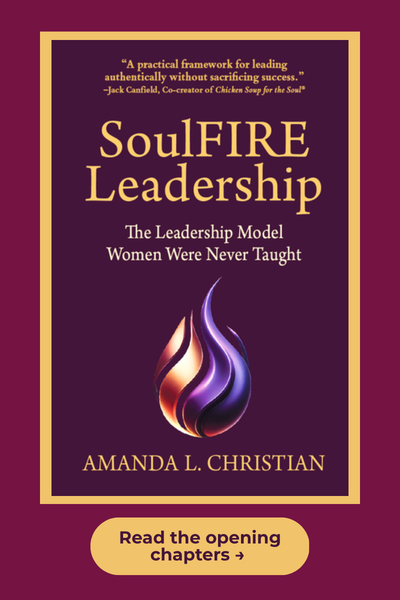
SoulFIRE Leadership is the framework built specifically for where you are, not where he was. It is the map that was never handed to you, written by someone who crossed the same terrain. Get your copy HERE.
The Real Difference Between Sponsorship vs Mentorship
A mentor tells you what to do. A sponsor puts you in the room where it matters.
That difference is not subtle. A mentor offers counsel privately. A sponsor advocates publicly, at the table where budgets are decided, where succession conversations happen and where the next assignment is being discussed before anyone has announced it. A mentor improves your thinking. A sponsor expands your visibility among the people who have the authority to advance your career.
Most women are advised toward mentorship. Most women need sponsorship.
What changed my own trajectory, not incrementally but materially, was not any piece of advice I received. It was the moment a senior leader started inviting me into rooms. Strategy sessions. Budget discussions. Conversations about organizational direction were happening long before any formal announcement. He was not just mentoring me. He was vouching for me, repeatedly, to people who had never seen me operate. That is sponsorship. There is no equivalent to it.
The best mentors I had also acted as sponsors. They did not just counsel me in private. They opened doors. They said my name in rooms I had not walked into yet. That combination is rare, and knowing the difference means you can identify when you are getting one without the other.
If you are sitting across from someone who gives excellent advice but whose influence stops at the edge of your conversation, you have a mentor. A good one, maybe. But not a sponsor. And right now, given what is happening in the market, only one of those two things changes your actual positioning.
I have written about how high performance alone is no longer enough in The Competence Trap. The women who stay invisible inside organizations are often the most capable people in the room. Delivery is not the problem. Visibility is. And a mentor who is not also your advocate is not solving for that.
The Question Worth Sitting With
The goal here is not to make you suspicious of every mentor you have. Some of the most valuable relationships in my career were with mentors who saw clearly, challenged hard, and opened doors they did not have to open. Those people exist, and they are worth finding.
The goal is to sharpen your discernment. To give you a better question than whether you have a mentor. The better question is this: Does my mentor's map match the territory I am actually crossing? And if the answer is not clearly yes, what would it mean to stop following directions designed for someone else's route?
Has anyone ever given you advice that was genuinely right for your career, not just their version of it?
Work With Someone Who Has Crossed This Terrain
If you want to look at your specific situation, the advice you have been following, where it has served you, and where it has not, book a Private Coaching Strategy Call.
Inbox clutter is exhausting. This isn’t that.
If you’re a high-achieving woman who’s done with leadership models that drain you, this is where it shifts.
You’ll get a monthly leadership newsletter, and the occasional insider-only invite.
Built for women who don’t have time to waste and don’t want to.
We hate SPAM. We will never sell your information, for any reason.